
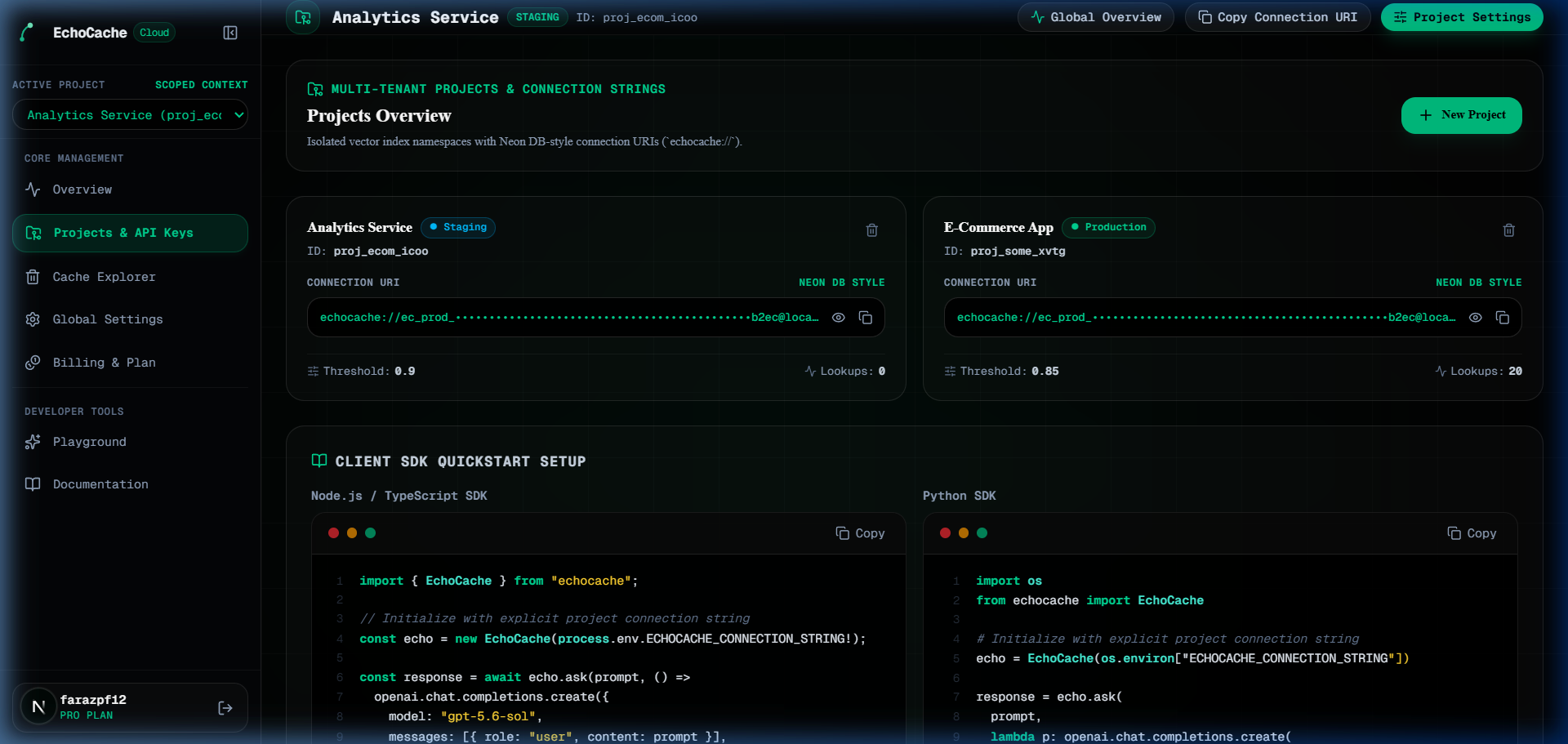
EchoCache is an enterprise-grade caching SDK designed to significantly reduce LLM API costs and accelerate response times. It intercepts your LLM calls, maps prompt semantics in a local vector space, and returns cached responses in under 10ms, saving up to 80% on API costs without blocking runtime execution. This solution is ideal for developers and organizations leveraging large language models (LLMs) from providers like OpenAI, Anthropic, Gemini, or custom REST clients, aiming to optimize performance and cost efficiency.
Key Features
- Semantic Vector Caching: Maps inputs into vector spaces to capture semantic equivalence, overcoming the limitations of traditional exact-match caches.
- int8 Quantized Payloads: Compresses vector dimensions using 8-bit scalar quantization, fitting more items into local cache indexes with zero latency degradation.
- Vector Similarity Search: Utilizes sentence embeddings and cosine distance to match prompts even when syntax is completely rephrased.
- Configurable Threshold: Allows fine-tuning confidence requirements per endpoint to balance accuracy against cache hit ratios.
- Drop-In Middleware & Provider-Agnostic Engine: Seamlessly wraps existing OpenAI, Anthropic, or custom REST client instances, working universally across various LLM providers and models.
- Parallel Background Threading: Pushes completions asynchronously in background threads, ensuring clients receive answers instantly without blocking writes.
Use Cases
EchoCache is highly beneficial for any application where LLM costs and latency are critical factors. For instance, in customer service chatbots, it can cache responses to common or semantically similar queries, drastically reducing the cost per interaction and providing near-instant replies to users. This significantly improves the user experience by eliminating wait times often associated with LLM calls. Furthermore, for applications involved in content generation, summarization, or code assistance, frequently requested topics or rephrased prompts can be served directly from the cache. This not only cuts down on expensive API expenses but also accelerates the delivery of results, making the application more responsive and efficient. It's particularly valuable for high-volume deployments where even marginal cost savings per query accumulate into substantial overall reductions.Pricing Information
EchoCache offers a flexible, usage-based pricing model, starting with a generous free tier that includes 10,000 cache lookups and 50 MB storage per month. Paid plans (Pro, Business, Enterprise) scale with increased lookups, storage, projects, and features like configurable similarity thresholds and priority support. An Enterprise option is available for custom requirements, including self-hosting, dedicated infrastructure, and advanced security features like SSO & audit logs.User Experience and Support
The SDK is designed for straightforward integration, requiring just three steps: installing the Node.js package, obtaining an API key, and wrapping existing LLM calls. A simulation environment is provided to help users understand cache MISS/HIT states. Comprehensive documentation is available, and support ranges from community assistance for free users to priority email support for higher-tier plans, ensuring a smooth onboarding and operational experience.Technical Details
EchoCache leverages advanced techniques including vector embedding spaces and vector similarity search (cosine distance) for intelligent semantic matching. It employs int8 scalar quantization for efficient payload compression, maximizing cache storage with minimal performance impact. The engine is provider-agnostic, supporting a wide array of models from OpenAI, Anthropic, Gemini, DeepSeek-R1, and open-source alternatives. It integrates as drop-in middleware and utilizes parallel background threading for asynchronous, non-blocking operations.Pros and Cons
- Pros: Up to 80% cost reduction on LLM API calls; Ultra-low latency responses (
- Cons: Requires initial SDK integration; May involve fine-tuning similarity thresholds for optimal performance; Primarily focused on LLM caching, not a general-purpose cache.
Conclusion
EchoCache stands out as an essential optimization layer for modern LLM-powered applications, delivering substantial cost savings and performance improvements through its intelligent semantic caching capabilities. By preventing redundant LLM calls, it enhances efficiency and user experience. Developers looking to elevate their LLM deployments should explore EchoCache to unlock its full potential and achieve significant operational advantages.Comments
Publisher

Launch Date2026-09-30
Platformweb
Pricingfreemium
Tech Stack
#Node#Python#LangChain
Sponsors

Boost Domain Rating
Get high-quality backlinks from trusted directories and climb your Ahrefs Domain Rating faster

Nick Launches
A launch platform for builders —> Get discovered, get a backlink.
Become a Sponsor
Get your brand featured here
Outbid
View🥇 🥈
🥈 🥉
🥉
Want this spot? Pay what you wantBoost Domain Rating - Boost Domain Rating is a platform to discover and upvote the best tech products. Find top products launching daily.
Boost Domain Rating is a platform to discover and upvote the best tech products. Find top products launching daily.
$35
DirEasy - The Best Directory Boilerplate with AI | DirEasy
The best directory boilerplate, packed with AI, Listings, Payment, Submission, CMS, Blog, Authentication, Newsletter, SEO and more.
$30
Quiz Shot - Solve Any Screenshot Question in Seconds.
AI Study Assistant that answers any screenshot question. Get free AI tutor and step-by-step math and homework help with ChatGPT.
$25