
This project is scheduled for launch
Launch date: Monday, November 9, 2026 at 08:00 AM UTC
Scheduled
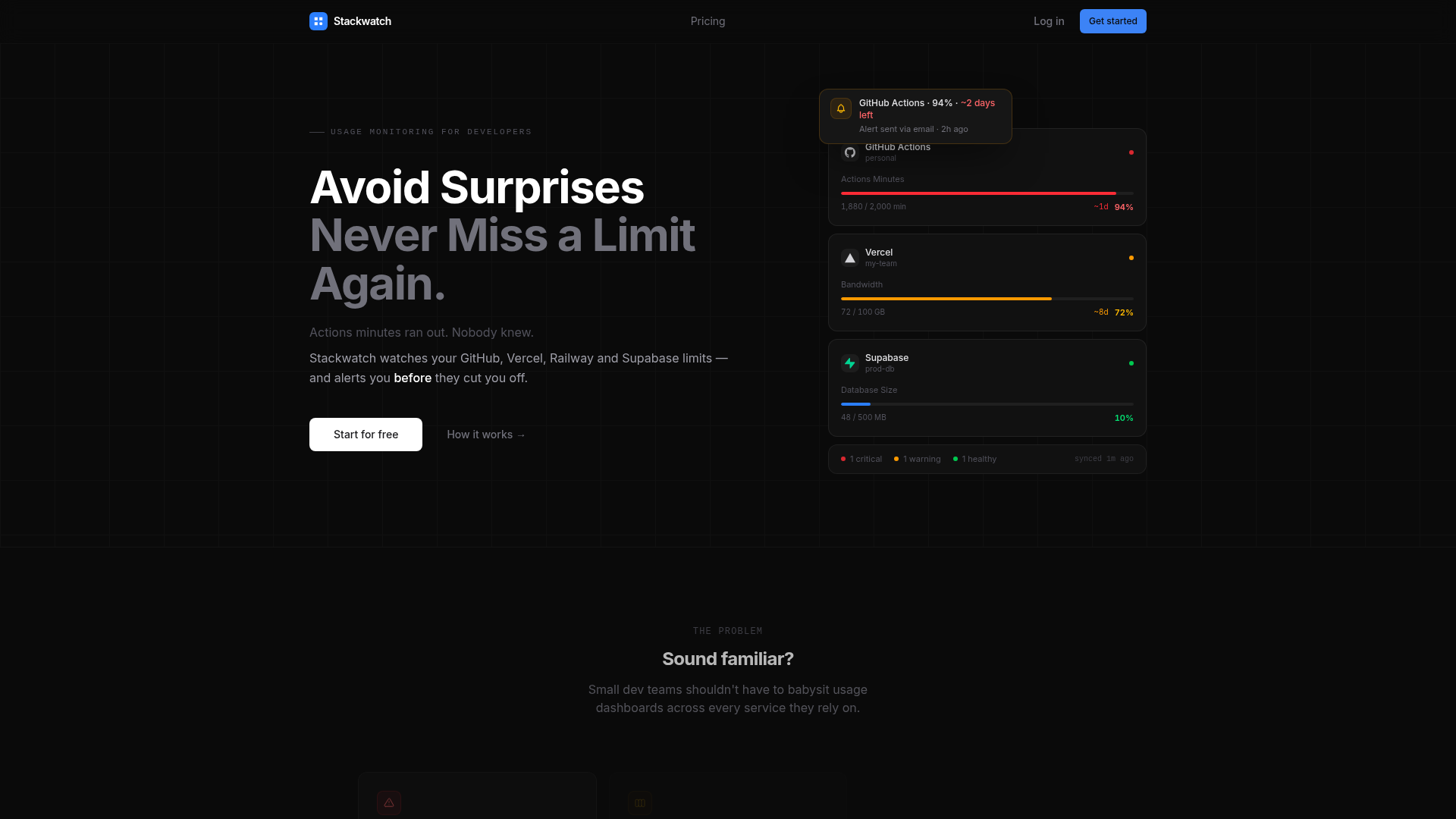
Stackwatch is a proactive usage monitoring SaaS designed for developers and small teams. It helps prevent unexpected service outages and cost overruns by tracking usage limits across critical platforms like GitHub, Vercel, Railway, and Supabase, alerting users before they hit their caps.
Key Features
- Multi-service integration: Connects GitHub, Vercel, Railway, and Supabase.
- Customizable thresholds: Set specific usage percentages for alerts (default 80%).
- Multi-channel alerts: Receive notifications via email, Slack, Discord, and Browser Push.
- Centralized dashboard: Monitor all service usage from a single, intuitive interface.
- Secure API key storage: Encrypted storage for all integration credentials.
- Detailed breakdowns: Per-repo, per-project, and per-service usage insights.
Use Cases
Stackwatch is invaluable for development teams who want to avoid the common pitfalls of hitting service limits. Imagine GitHub Actions minutes running out mid-sprint, halting critical deployments, or Vercel bandwidth cutting off your users, leading to a poor customer experience. Similarly, Supabase row limits can silently fail writes, causing data integrity issues. Stackwatch addresses these problems by providing timely alerts, ensuring continuous operation and preventing costly interruptions. Instead of manually checking multiple dashboards across different services—GitHub, Vercel, Supabase, Railway—and inevitably forgetting, Stackwatch centralizes this monitoring. It eliminates the need for constant vigilance, allowing teams to focus on development rather than babysitting usage metrics. This proactive approach ensures that usage spikes are caught early, preventing services from being cut off at the worst possible time.Pricing Information
Stackwatch operates on a freemium model, allowing users to start for free without a credit card. The 'Free' tier is ideal for solo developers, offering 1 account per service across 4 services, email alerts, 15-minute polling, and 7-day alert history. The 'Pro' plan, at $10/month, caters to individuals with multiple projects, providing 5 accounts per service, per-project breakdowns, additional alert channels, 5-minute polling, and 30-day history. For teams, the 'Team' plan at $30/month offers unlimited accounts, all services, multiple notification support, 1-minute polling, 90-day history, and a team dashboard.User Experience and Support
Setting up Stackwatch is designed to be quick and hassle-free, taking less than 2 minutes. Users simply connect their services by pasting API tokens, which are securely encrypted. The dashboard provides a clear, live preview of usage, making it easy to understand current statuses. Alerts are delivered to channels where users already work, ensuring they don't miss critical notifications. Support is available via a 'Send us a note' option and a comprehensive FAQ section.Technical Details
Stackwatch integrates with services using their respective API keys, such as GitHub PAT, Vercel API token, and Supabase Management API key. These credentials are encrypted and stored securely, with the option for users to remove them at any time. The system polls usage data at configurable intervals, from 15 minutes down to 1 minute for higher tiers, to provide near real-time monitoring.Pros and Cons
- Pros: Prevents unexpected service interruptions and costs; Centralized monitoring for multiple services; Customizable and multi-channel alerts; Quick and easy setup; Freemium model available; Secure handling of API keys; Reduces manual checking overhead.
- Cons: Limited number of integrated services (though more are coming); Free tier has slower polling and shorter history; Relies on users providing API keys (though secure).
Conclusion
Stackwatch offers an essential solution for developers seeking to maintain operational continuity and manage costs effectively by proactively monitoring service usage. Its intuitive interface, robust alerting system, and multi-service integration make it a valuable tool for any development workflow. Explore Stackwatch today to gain peace of mind and avoid usage limit surprises.Comments
Comments will be available once the project is launched.
Publisher

Launch Date2026-11-09
Platformweb
Pricingfreemium
Tech Stack
#nextjs#express#react#javascript
Sponsors

Boost Domain Rating
Get high-quality backlinks from trusted directories and climb your Ahrefs Domain Rating faster

Nick Launches
A launch platform for builders —> Get discovered, get a backlink.
Allwebforms
Build free online forms, surveys, and lead funnels with Allwebforms. No-code builder with AI, email alerts, and 300+ integrations. Advanced Visitor analysis, notifications, Online visitors, Submission-started notifications, and more.
Become a Sponsor
Get your brand featured here
Outbid
View🥇 🥈
🥈 🥉
🥉
Want this spot? Pay what you wantBoost Domain Rating - Boost Domain Rating is a platform to discover and upvote the best tech products. Find top products launching daily.
Boost Domain Rating is a platform to discover and upvote the best tech products. Find top products launching daily.
$35
DirEasy - The Best Directory Boilerplate with AI | DirEasy
The best directory boilerplate, packed with AI, Listings, Payment, Submission, CMS, Blog, Authentication, Newsletter, SEO and more.
$30
Quiz Shot - Solve Any Screenshot Question in Seconds.
AI Study Assistant that answers any screenshot question. Get free AI tutor and step-by-step math and homework help with ChatGPT.
$25